How to Estimate Rehab Costs Before You Buy the Deal
Most bad flips do not fail at the sale.
They fail before the offer.
That is where the investor walks the house, sees paint, flooring, cabinets, and a few obvious repairs, then throws a rough rehab number into the spreadsheet because they want the deal to work.
The ARV looks good. The spread looks good. The photos look manageable.
Then the roof needs more than a patch. The HVAC is tired. The plumbing run is longer than expected. The deck is rotted behind the siding. The contractor bid was vague. The permit process takes longer than planned.
Now the investor is not flipping a house.
They are trying to survive a budget they guessed at.
If you want to learn how to estimate rehab costs before you buy the deal, start with this:
Your repair number controls the whole deal.
It controls your offer price, financing, timeline, holding costs, resale strategy, and stress level.
So before you chase the deal, know your numbers.
The Rehab Number Is Not Separate From the Deal
A rehab estimate is not construction trivia.
It is risk control.
If your repair number is wrong, everything downstream gets worse. You borrow too little. You hold too long. You run out of margin. You start making emotional decisions because you are already in the deal.
That is where investors get hurt.
The repair budget is not separate from the deal analysis.
It is the deal analysis.
Start With the Exit
Before I estimate repairs, I want to know what the property is supposed to become.
A flip, a rental, and a wholetail are not the same project.
On a flip, buyer-facing finishes matter. I care about the comps, resale expectations, kitchens, bathrooms, flooring, lighting, curb appeal, and the overall feel of the house.
On a rental, I care more about durability. I want functional, clean, code-safe, tenant-resistant choices that reduce future maintenance.
For example, I may reglaze a shower for a flip if it makes sense. On a rental, I usually would rather pay more upfront for something that will last instead of doing the same repair three times over the next 10 years.
Same property. Different exit. Different budget.
The exit tells you the scope.
The scope tells you the number.
Do Not Chase the Top of the Market
One of the biggest mistakes I see newer investors make is trying to rehab all the way to the top comp.
I do not like playing that game.
If the comps say the top of the market is $500,000, I am not trying to build a $500,000 house. I would rather come in around $475,000, sell faster, and leave myself some breathing room.
That does not mean cheap.
It means smart.
The goal is to give buyers the nicest, cleanest, most functional house you can for that market, with the least money out of your pocket.
Fix what needs to be fixed.
Replace what has to be replaced.
Pick finishes that appeal to the largest number of buyers.
That is the game.
Every time you catch yourself saying, “Well, I would want that in my house,” you are probably spending profit.
Use Real Southern California Cost Ranges
Repair costs move by city, crew, materials, access, permits, and how fast you need the work done.
But you still need real ranges in your head.
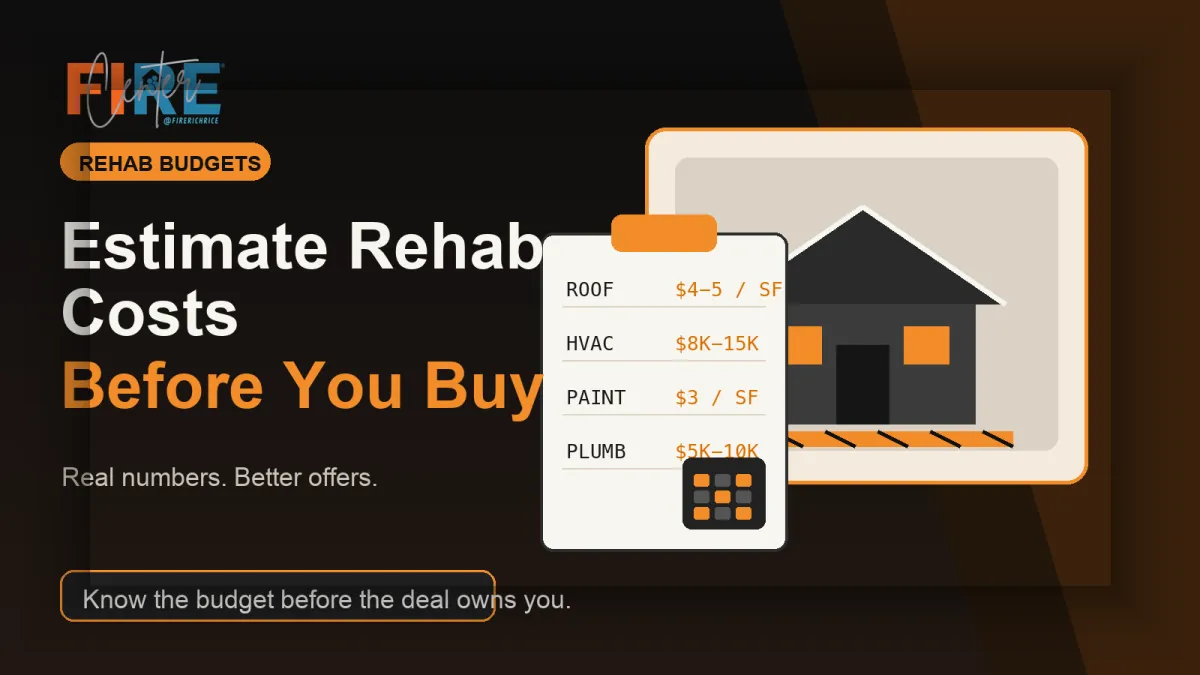
Here are examples I teach from real Southern California rehab experience:
- Roofing: One square of roofing is 100 square feet. Material can be around $4-5 per square foot. Tear-off on a 1,000-2,000 square foot house can add $1,000-2,000. Full sheathing can add another $1,000-2,000 if the roof needs it.
- Windows: Replacing glass can be as little as $100. Retrofit windows may be around $250 for the window and $250 to install. New construction windows can run $1,000-1,500 each.
- Decks and stairs: Demo can run $1,500-5,000. A staircase can run $5,000-10,000. A large deck can hit $20,000. Large multi-level decks with stairs can go $50,000 plus.
- Exterior paint: Around $4-5 per square foot. A 1,500 square foot house may land around $7,000 depending on prep.
- Electrical: Panel swaps can run $3,000-5,000. A sub-panel may be around $1,500. Switches and outlets can be $20-30 each. An easy 220v run under 50 feet may be under $1,000.
- Septic: A new system can run $8,000-15,000. Special treatment systems for ADU situations can be $25,000 plus. Pumping and inspection can be around $500 each.
- Plumbing: Hooking up sinks and drains can be around $300 per sink. New valves may be $75 each. Toilet install may be $150. Replacing entire main waste lines can run $5,000-10,000. A 3-foot section can be $1,500-3,000 depending on depth and urgency.
- HVAC: New central heat and AC with new ducting can run $12,000-15,000. Using existing ducting may be $8,000-10,000. Adding AC to existing central heat can be around $6,000. Wall heaters can run $1,500-2,500. Mini splits can be around $1,100 for 120v units, $2,000 for 220v units, plus more for multi-head setups.
- Interior paint: A full one-color paint job in a 1,500 square foot house may be around $5,000. Around $3 per square foot is fair, with more for two-tone, different sheens, or heavier prep.
These are not universal prices.
They are ranges to keep you from lying to yourself.
If your spreadsheet says the rehab is $35,000 but the house needs roof, HVAC, paint, plumbing, and flooring, you are probably not estimating.
You are hoping.
The Big Stuff Comes First
When I walk a property, I do not start with the pretty stuff.
I start with the expensive stuff.
- Roof
- Foundation and structure
- Electrical
- Plumbing
- HVAC
- Windows
- Decks, stairs, siding, and exterior issues
- Permits and engineering
Paint and flooring matter, but they are rarely the thing that destroys the deal.
The budget killers are usually hiding in systems, structure, permits, dry rot, sewer, septic, roof layers, bad electrical, or a contractor scope that did not say what you thought it said.
That is why “rehab: $50,000” is not enough.
Build the number from the property.
Assume Nothing in the Scope
The golden rule of rehab is simple:
Assume nothing.
A vague contractor bid is not a scope of work.
“Paint the house” is not enough.
What paint? What color? What prep? Are they scraping? Priming raw wood? Painting doors, jambs, closets, baseboards, fascia, eaves, cabinets, trim?
I once had a contractor misunderstand a paint direction so badly that I changed the way I write instructions.
Now I use circles and check marks for what I want. Multiple lines through what I do not want. Specific colors. Specific areas. Specific materials.
Because if you are not clear before the work starts, you are going to pay for the confusion later.
Do Not Be Cheap in the Wrong Places
There is a difference between being efficient and being cheap.
Being efficient protects profit.
Being cheap creates future problems.
I still catch myself wanting to do little things to “save” $200. Smoke detectors. Cabinet pulls. Door stops. Easy stuff.
Then it always comes time to do those things when my hair is on fire somewhere else, and I wish I had just paid the $200.
Your job is not to swing the hammer.
Your job is to manage the project, protect the budget, make decisions, and keep the deal moving.
How to Verify the Rehab Estimate Before You Offer
Before you make the offer, pressure test the number.
- Walk the property with the exit in mind.
- Separate cosmetic work from systems and structural work.
- Use local cost ranges, not national calculator guesses.
- Write a rough scope before you ask for pricing.
- Ask what is included and excluded in every bid.
- Add contingency before closing, not after the surprise hits.
- Bring the deal to people who actually do this work.
You do not need to know everything before you write offers.
But you do need a process.
If you cannot explain the scope, you cannot price the scope.
And if you cannot price the scope, you do not know what the deal is worth.
The FIRE Center Way
Online calculators can help.
But they do not know your city, your contractor, your exit, your timeline, your financing, or your risk tolerance.
That is why I like real-world deal review.
At the FIRE Center, the goal is not to make every deal look good.
The goal is to find the truth before you put money at risk.
If you are looking at a property and the repair number feels like a guess, bring it to Deal Room before you make the offer.
Bring the photos, rough scope, ARV, and contractor bid if you have one.
Let other investors help you pressure test the number.
One avoided bad rehab can save you more than a year of membership.
Want the Full Rehab Breakdown?
I teach this in depth inside the FIRE Center.
The class is called Master Your Flip & Rehab Strategy, and members get access to the full rehab training.
We also have the July 18-19 rehab class coming up, where we will go deeper on estimating repairs, budgets, scopes of work, contractors, permits, roofs, HVAC, plumbing, finishes, inspections, and how to avoid the expensive mistakes that wipe out profit.
If you are serious about doing deals, become a FIRE Center member here and get access to the kind of training you want in your head before you buy.
Numbers before emotions.
Scope before offer.
Contingency before close.
That is how you estimate rehab costs without getting crushed.
Rich